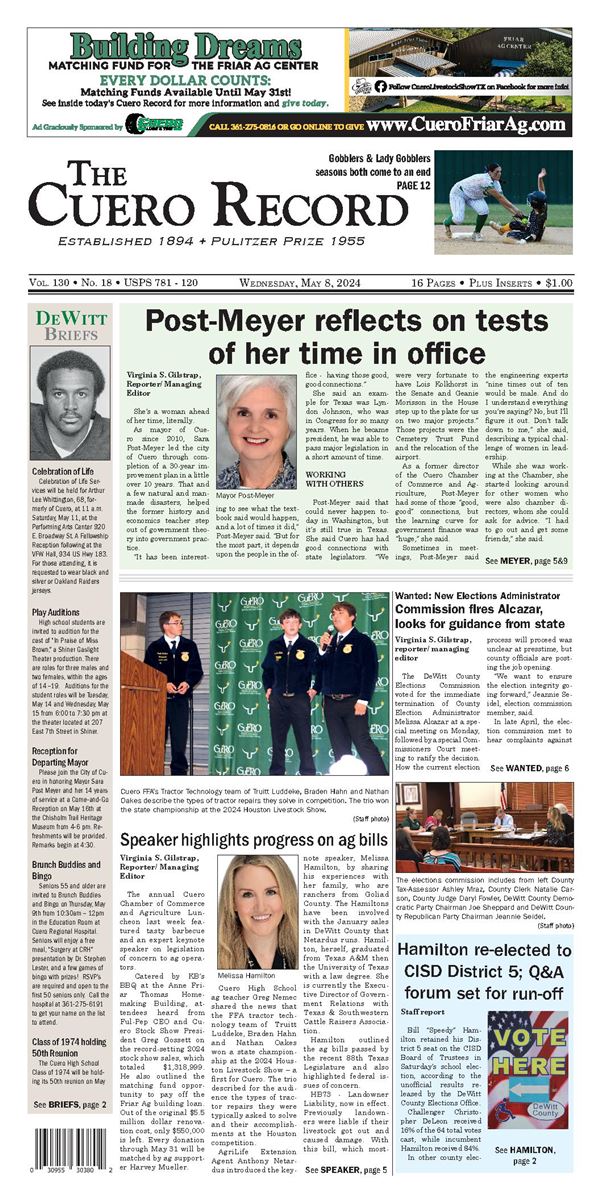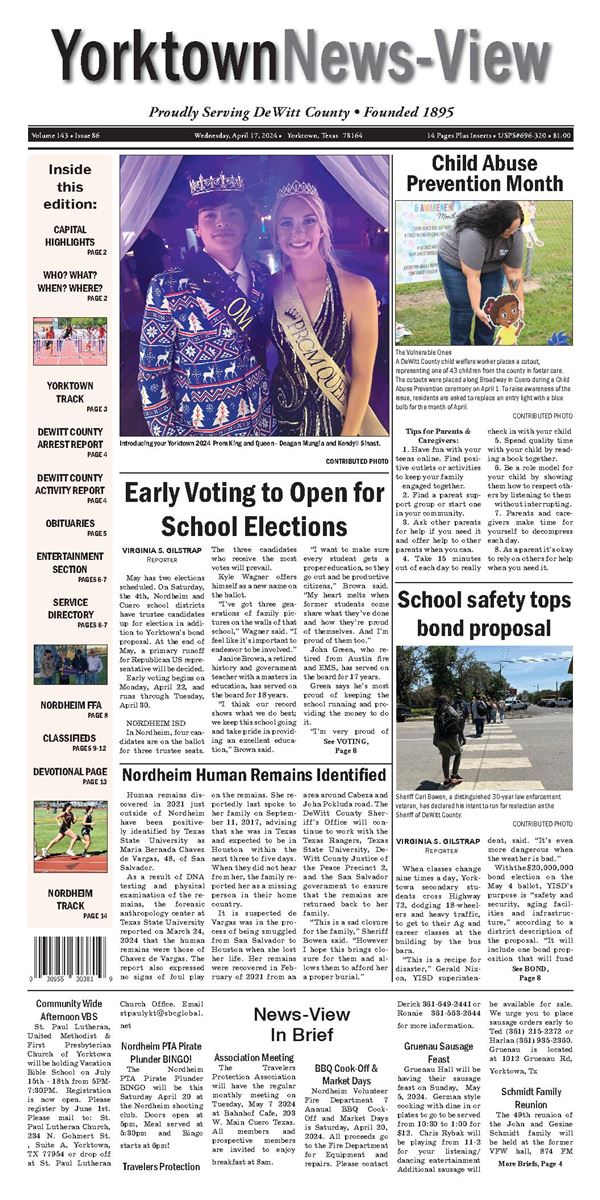



The next generation of ag producers were highlighted at the third annual Cuero Chamber of Commerce Ag Luncheon on April 23. So naturally, A&M’s Vice Chancellor & Dean for Agriculture & Life Sciences was tapped as its keynote speaker. Also, the labeling threats to the American beef industry were outlined by a speaker from the Independent Cattleman’s Association.
Held at the Ag Friar Center and sponsored by the Cuero Chamber of Commerce & Agriculture, the luncheon was catered by KB Barbecue.
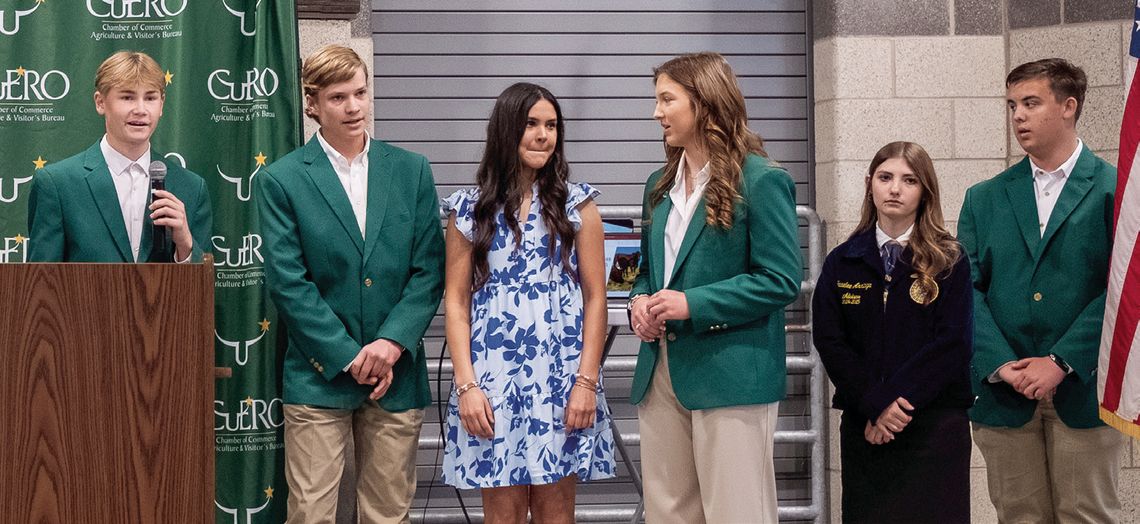
It opened with the student spotlight of the 4-H Ambassador Program and the championship livestock judging team headed to international competition in Scotland.
AgriLife Extension Agent Denise Goebel introduced the 4-H Ambassadors on behalf of fellow Extension Agent Candace Williamson, who was out on maternity leave. Williamson joined the county’s AgriLife office last year and oversees the county’s youth programs.
Goebel said Williamson was passionate about getting the Ambassador program started to teach youth about leadership in the community.
“She’s getting them involved in the community to learn all aspects of local government in communities and what it takes to make our community flourish,” Goebel said.
The Ambassadors in attendance who wore the signature green coats were Caleb Keller, Andrew Hahn, Ella Jander, and Gunnar Frank. Not present was Jana Justiss.
Cuero High School Ag Instructor Kim Hahn introduced herself as one of four ag teachers at the high school, saying their class sizes are “very large and keep increasing yearly.” She highlighted the accomplishments of the school’s FFA students in competition, including the Houston Livestock Show.
The other students featured were the DeWitt County Livestock Judging Team of Trent Luddeke, Jackie Finney and Percy Torres. The fourth member, Nathan Oakes, competed as a senior and is now away as a college freshman. The team described their experiences leading up to the national competition in Denver, which earned them a place on the US team at the international competition in Scotland.
Coach Amanda Luddeke thanked the audience for supporting the team.
“We cannot thank you enough for your unwavering support. It is a humbling experience as we get ready to go to Scotland,” she said.
A&M Vice Chancellor & Dean
Following the student spotlight, keynote speaker Dr. Jeffrey Savell joked that with all the students in the audience, he felt like a minister giving the final call while sharing about all that A&M offers the agricultural industry.
“I feel like a Baptist minister right now, but the invitation is always there, you know,” Savell said. “And at the end of this, everybody who wants to can come up to the front and kind of devote your life to Texas A&M.”
The Chancellor was introduced by a former student whom he advised on his thesis: Cuero’s own Greg Gossett, president of the Cuero Livestock Show and Full O’ Pep CEO. Gossett and Savell remained close over the many decades since his college days.
As a scholar, Savell’s work was among his field's top 2% most cited researchers in 2024. Under his direction, the Agriculture & Life Sciences division saw freshman enrollment increase by 40%.
Savell said A&M has the most comprehensive agriculture program in the United States.
“Nobody comes close to that in the volume of work we do, the number of people committed to doing that,” he said. “There's 5,000 people that work in that whole enterprise.”
As vice chancellor he oversees the AgriLife system, which he described as a holding company, encompassing the areas of research, extension agents, medical diagnostic labs and the forest service.
Savell commented on the rain that morning in relation to the forest service. “With rain comes grass, with grass it finally dies and we’ve got more wildfire opportunities. So we’re either creating more fuel or we're putting out things, but it's all just part of all the things we get involved in.”
As for the Agriculture & Sciences studies, Savell mentioned careers, such as hospitality and tourism as well as financial planning, that may not normally seem agriculture related.
“Think about people going on retreats. Think about those wanting venues,” he said.
Savell said today’s students “are the ones going to be solving problems after we're all gone. We gotta be able to invest in them to be able to make things happen.”
He advised the students to think of the ag industry as a people industry.
“Subject matter is important. You'll find the subject matter that you love,” he said. “But it's going to be your ability to work with people that’s going to make a difference in everything that you do. If you're going to really go far in this life, you've gotta be able to know that you're in the people business and work hard.”
After the keynote speaker representatives from the Texas Railroad Commission provided insights into their regulatory roles and community engagement.
Beef Labeling
The final speaker was Cooper Little from the Independent Cattlemen's Association, who talked about major legislative efforts to protect beef labeling and to prohibit cell-cultured meat in Texas.
“One's a federal bill up in the US Congress, and one is a state bill currently making its way through our state capital, there in Austin,” he said.
The federal legislation is the American beef labeling act currently in the US Senate, which would reestablish country of origin labeling for US beef products.
“Currently, foreign beef can have the trusted label American cattlemen and cattle women have built for generations,” Little said. “And it's just plain wrong.”
He urged audience members to contact the Texas senators to get their support for the bill.
In the Texas Legislature, Little said a bill related to cell-cultured meat is making its way through the process.
He said the USDA has temporarily granted these products generic label authority, “meaning that they may call themselves beef, temporarily without a differentiator.”
Little said there have been no short term or long term animal or human studies on the product and that none were planned.
“We thought that was pretty wild,” he said. “That would indicate that the public, the consumers would be the guinea pigs.”
Little said the product is illegal in every country except for three: the U.S., Israel and Singapore.
He said that until the safety of it has been studied, Texas should prohibit cell-cultured meat and urged the audience to let their state representatives know of their support for the bill.