


Staff R eport Two of Texas A&M’s Life Science experts were on the frontlines of Florida’s 2016 New World screwworm eradication efforts. Their lessons learned are now helping shape science- based outreach, surveillance and containment strategies in Texas.
During the Florida outbreak, the work of Roel Lopez, Ph.D., Texas A&M College of Agriculture and Life Sciences director of the Texas A&M Natural Resources Institute and head of the Texas A&M Department of Rangeland, Wildlife and Fisheries Management, and Phillip Kaufman, Ph.D., head of the Department of Entomology, offers critical insight into what’s at stake and how early action can make a difference.
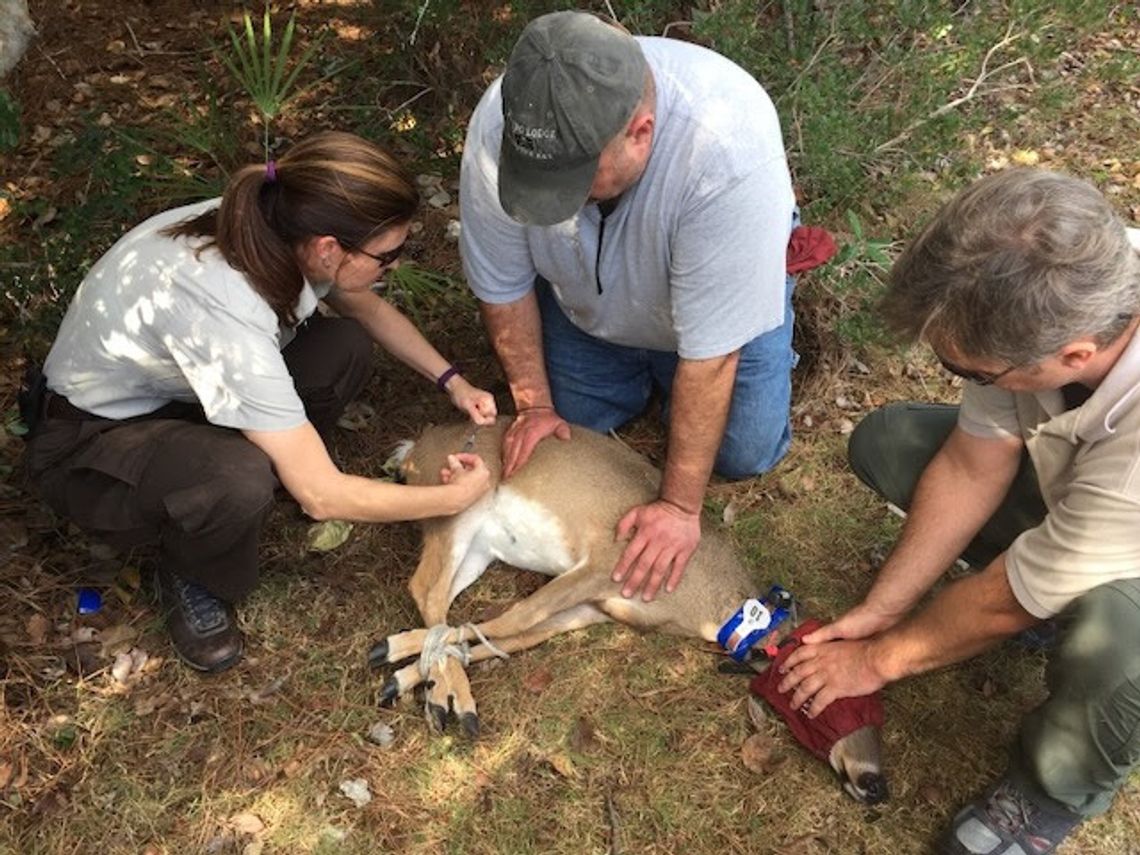
The outbreak impacted one of the state’s iconic and federally endangered wildlife species — the Key deer.
Reflecting on new screwworm infestation
The first confirmed infection of New World screwworm in Key deer was in 2016. It marked the first U.S. outbreak of New World screwworm in more than 30 years.
Lopez said this caught many wildlife biologists off guard.
“Frankly, many of us who had never dealt with New World screwworm were unsure of the survival of Florida’s Key deer,” he said.
The Key deer is the smallest subspecies of white-tailed deer and only inhabits the Florida Keys, a string of islands off the southern tip of the state.
As a longtime researcher of the deer’s habitat use and population ecology, Lopez and others in the Texas A&M Natural Resources Institute were called upon by the U.S. Fish and Wildlife Service to monitor Florida Key deer populations. Asked to assess the impact of the infestation and aid in establishing recovery strategies, his team’s fieldwork became part of a large-scale, coordinated response effort.
From Florida entomologist to Texas advisor
Similarly, at the time of the outbreak, Kaufman served as University of Florida’s Institute of Food and Agricultural Sciences Extension scientist and associate professor. At the time, he was a key source of information on the New World screwworm fly and its biology, much like his current role with Texas A&M AgriLife’s response.
“County Extension agents are who local populations go to for answers,” Kaufman said. “It was up to us to provide them with the most up-to-date materials, so they knew what was occurring and what to be on the lookout for.”
Response leads to containment,
eradication
Containment and eradication efforts in Florida relied on a rapid, united multi-agency effort. Strategies included the release of sterile male flies, mandatory checkpoints, treatment of impacted and vulnerable animals with deworming agents, and ongoing monitoring. Within months, the outbreak was contained and the New World screwworm ultimately eradicated in Florida.
“It took a tremendous amount of coordination between various agencies and groups to reach that point,” Lopez said. “The biggest lesson I learned was the importance of rapid, interagency coordination. No one agency can do it themselves — it requires a cohesive effort.”
Although the infestation did not spread to Florida’s mainland, infecting additional wildlife or impacting the state’s livestock industry, its dramatic effects were still felt. In a matter of months, approximately 15% of the Key deer population was killed.
Vigilance, reporting needed
Although the New World screwworm has not yet crossed into Texas, Lopez and Kaufman urge vigilance from landowners, veterinarians and wildlife managers, asking them to report any suspicious cases that could indicate its presence.
“If you see something, say something,” Lopez said. “It is better to have been mistaken than to inadvertently allow this pest to gain a foothold in the state.”
According to both Lopez and Kaufman, if the New World screwworm does cross into Texas, the impact on the state’s wildlife and livestock could be devastating — both ecologically and economically. For instance, white-tailed deer hunting alone annually contributes billions of dollars to the Texas economy.
“The biggest challenge with wildlife is monitoring and early detection,” Lopez said. “With this in mind, investigation of suspicious mortalities or the use of game cameras can serve as an invaluable tool for landowners to monitor wildlife health and document any signs of infection.”
Kaufman said confined wildlife operations should develop herd management plans similar to those used by livestock producers.
“If you are running a wildlife facility, you need to have a biosafety plan,” he said. “Develop a surveillance program for your ranch and have a list of veterinarians and resources on hand.”
In some cases, Kaufman said these operations may consider equipping their most high-value animals with tracking devices to monitor their movements.
“The outbreak in Florida occurred without any prior warning indicators,” Kaufman said. “Because we are currently aware of the New World screwworm’s northern movement in Mexico, Texas is in a better position to proactively plan and execute an effective response.”
How to report suspected cases
Texans should promptly report signs of New World screwworm: Domestic animals: Contact your local veterinarian.
Wildlife: Contact your Texas Parks and Wildlife Department county wildlife biologist.
State and federal reporting: Texas Animal Health Commission: 800-5508242 U.S. Department of Agriculture Veterinary Services: 512-383-2400.