


Once upon a time, there was a very young community here in De-Witt County that was so small in population that it couldn’t be called a town and was instead known as a settlement. This settlement had a few dozen farm and ranch homes or log cabins spread about, and at its center were some five or so buildings of simple construction and mostly for business. These buildings included a blacksmith shop, a grocer, a dry goods mercantile, a stagecoach stop and inn, a tannery (where animal hides and pelts were being prepared and traded) and after the people pooled their money, a schoolhouse. There could also have been a doctor’s office combined with a drug store and after enough money was raised, a church.
It was the late 1840s in DeWitt County, when currency wasn’t available and as the citizens worked the land, the results such as crops and meats from animals, were what they lived on. These were also a means for them to barter and trade for different foods, household items, livestock, seed, and other needs and an occasional want. The most common form of currency, or money, in De-Witt County at this time was animal hides and pelts that people had hunted, raised, or trapped and then skinned for tanning. Hides and pelts were used as a form of money because of their usefulness and value across the country in making clothing and household items.
Now, the schoolhouse was a new, sin-gle-room structure in about the year 1848. Inside this schoolhouse began the endearing story of Dish-Rag, a nickname given by the DeWitt County schoolchildren in the 1850s. It’s been about 171 years since this story came about, and the schoolhouse and settlement to which it belonged are gone. All of the schoolchildren, who once passed through its doors upon hearing the teacher ringing the school bell are also gone. Yet, there is one vague and slowly blurring story from this DeWitt County schoolhouse which lingers today. This story will forever belong to those precious schoolchildren, their one room schoolhouse, and to all of us who call DeWitt County home.
In 1848 (and into the 1900s), there was no requirement that children attend school and families that permitted their child to some form of education, had no choice but to buy the schoolbooks, not just the school supplies. Schoolbooks were costly items. Families would struggle to find money to buy school supplies, only to realize the dream of sending a child to school was unattainable due to the regular costs associated with buying a schoolbook or schoolbooks. To offset the cost of schooling, this particular DeWitt County settlement would pool their money to buy a book or two for the schoolhouse. At that time, the community could afford one primary reader schoolbook. This schoolbook was shared by all the class of 1848 schoolchildren who were learning the alphabet and then every new class thereafter, into the 1850’s and possibly the 1860s.
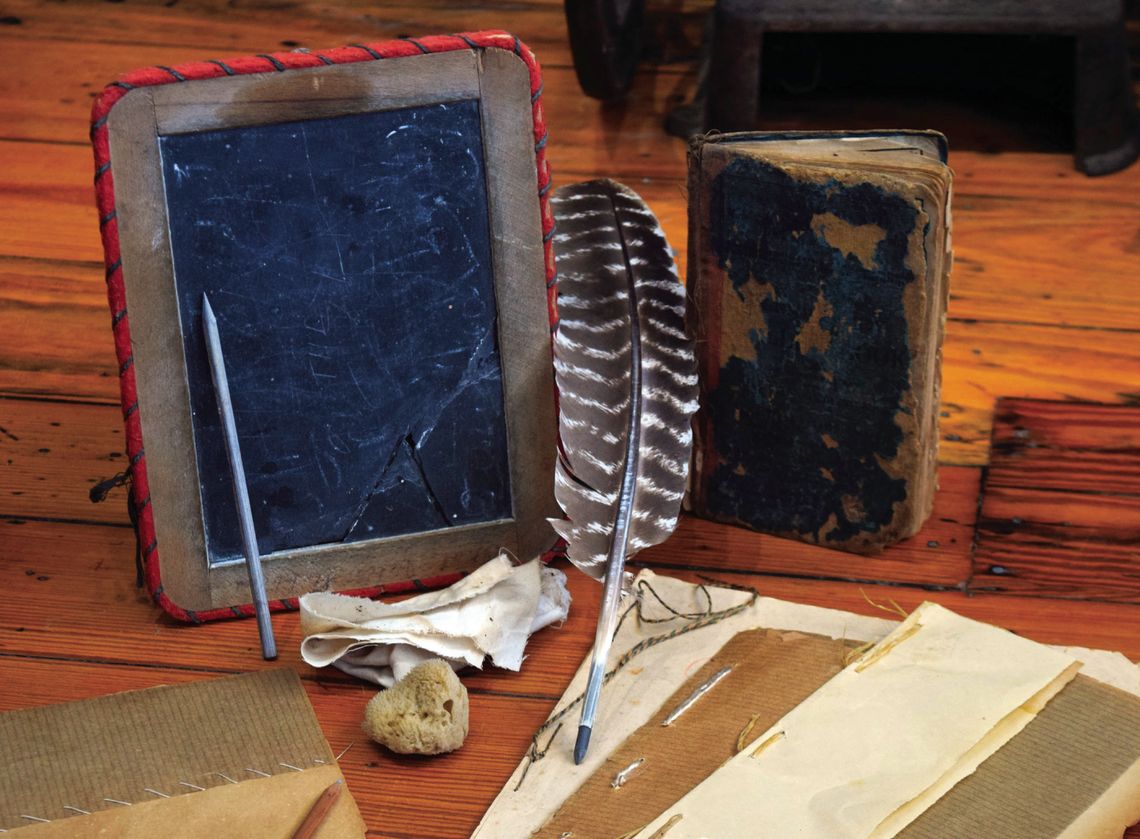
As the years progressed, the students gave their shared schoolbook a nickname, “Dish-Rag.” The schoolbook had become tattered and worn and must have been something to behold. Being handled so much, by schoolchildren and perhaps adults, had caused the colorful book cover paper to discolor and altogether wear away in places. The schoolbook cover started showing the cardboard hardcover. First along its edges and sides and then both front and back. Dish-Rag’s spine may have been glued and stitched several times over its many years of use and the pages within may have been torn, written on or missing. By the mid1850s, the schoolbook’s appearance resembled their mother’s household dish-rag because of its many years of service to the schoolchildren of the community.
There were other school supplies which had to be purchased by parents, including a rock tablet and pencil, both made of slate rock that was carved into the shape of a writing tablet and pencil. It’s fair to say students once used rock paper and pencils and did so well into the 1900s. Slate is a delicate material and care had to be taken so as to not break the writing tablet and pencil. As an eraser for the slate writing tablet, either a small sponge or a discarded piece of cotton or linen cloth was used to remove slate marks from the tablet and teachers could be adamant on requiring erasers so as to keep the students from using a spit and shine method with their shirt cuff or hand.
Here in DeWitt County, when a slate pencil broke or became too small to handle, a wild turkey feather would be found to hold the remains of the pencil for its continued use as pencil quill, until the slate pencil was completely gone. When a slate writing tablet broke, the shards were collected and soon carved into slate pencils. Writing paper was hard to come by and it was considered a luxury item by everyone.
DeWitt County phy- and surgeons of the 1800s experienced this first hand when it came to writing prescriptions and would use envelopes, magazine pages and advertisements and scrap paper to record their patient’s medicinal recipes. Due to the scarcity of paper, students eventually learned to sew. They would make their own “blue paper” which in the 1800s meant finding used or discarded writing paper, wrapping paper, envelopes and similar scrap paper to then sew together into larger, normal sized sheets of paper. Several sheets of sewn blue paper would then be bound and sewn together along a spine to make a composition book. Older students would take penmanship classes so pencils and pen and ink had a variety of uses.
Apothecaries or drug stores were usually the only place to buy and order schoolbooks and school supplies. Should you wish to meet a version of Dish-Rag and view school supplies from the 1800s, come by The Pharmacy & Medical Museum of Texas, Tuesday through Saturday, 10 a.m. to 3 p.m. or schedule a visit with us.
The specific DeWitt County schoolhouse that Dish-Rag is connected to is lost to time and while this is unfortunate, it allows all of DeWitt County to claim a share of Dish Rag’s story. Don’t let the Story of Dish-Rag disappear. There is only one other reference from 1943. This here ends the Story of Dish-Rag, and as DeWitt County residents would say in the 1800s, “May your days be filled with just enough clouds to make one beautiful sunset”.
Contributing Writer