



When his father decided to retire back in 2019 after 50-plus years in the seed business, Dr. Richard Myrick said he had just one question for his dad: After so many years out in the field, what did he think were some of the greatest advances in agriculture?
The elder Myrick didn’t bat an eye.
The eradication of the screwworm and invention of the round bale, he replied.
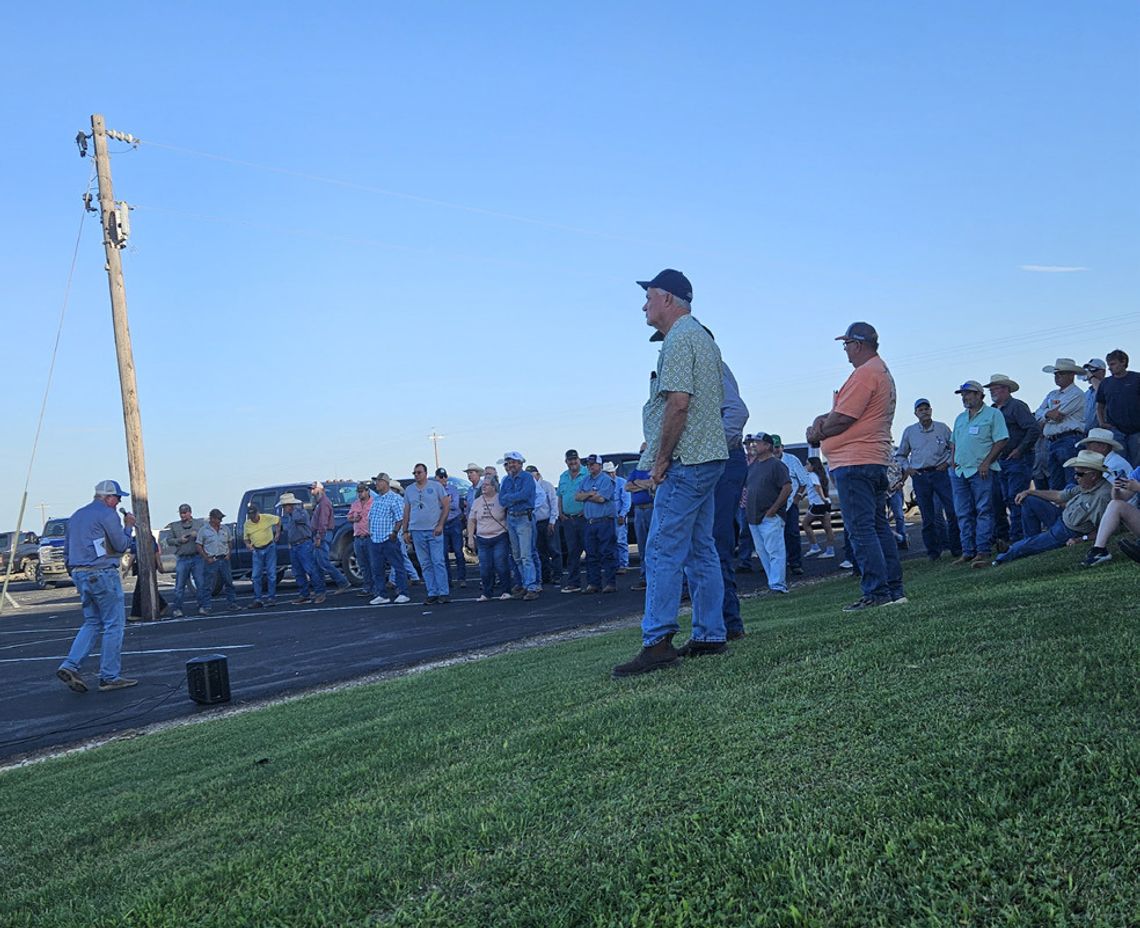
“Never in my wildest dreams, back when he said that, did I ever think I’d be standing here now talking about the screwworm’s return to Texas,” Dr. Myrick said before a full house Tuesday at Gruenau Hall.
But he was, and he did.
In fact, as a veterinarian with the Texas Animal Health Commission (TAHC) over the Giddings region, encompassing multiple Central and South Texas counties in what’s become the nation’s single largest cow-calf producing region, Dr. Myrick has been at the forefront of the screwworm battle for months already, well ahead of parasitic pest’s confirmation in Texas earlier this month.
By June 13, the total screwworm count had climbed to nine confirmed cases so far, most involving young calves in counties found along the Rio Grande borderland country between Del Rio and Laredo. Just two of nine known cases at that time had crossed species: One involved a goat in Gillespie County, and the other was a dog out in Andrews County, near the Texas-New Mexico border.
The canine case, which involved a small lapdog that recently traveled into the heart of Mexico with its owner, seems unrelated to the naturally occurring spread along the South Texas border. That same case is also responsible for adding New Mexico to the list of affected states, as the dog and owner technically reside there.
Already, quarantine zones have been established in affected counties, and federal and state inspectors are monitoring all animals in and around the affected zones.
State and federal agencies are also actively dealing with the screwworm itself, releasing thousands of sterile male screwworm files into impacted areas. Plus, ranchers and landowners statewide are being urged to stay especially vigilant with their herds this summer and report immediately any signs that might suggest screwworm flies have made it beyond existing quarantine zones.
Sadly, Dr. Myrick noted that the very same industry innovations his father listed back when, both making it possible for cattlemen and landowners to take up ranching from afar, could well prove the greatest stumbling block in dealing with the screwworm today.
While reviewing several successful options available for treating and preventing screwworm infestations during his talk last week — nearly all of which require a veterinarian’s prescription — he said just one method truly works.
“The best thing you can put on your cows for screwworms is a pair of eyes,” Dr. Myrick said. “Then, if you see something, report it. It’s the only way we get a handle on this.”
How did it get here? The screwworm — which technically isn’t a worm at all but rather a parasitic fly larva that feeds on the living tissue of most any warm-blooded animal — is hardly new to the Texas landscape.
Female flies, attracted by the scent of blood in an open wound, will land and lay eggs there. Those eggs hatch and the larvae begins burrowing its way into the animal’s flesh, causing severe irritation, infection and, left unchecked, eventually death to the host animal.
First identified in Texas during 1930s — though believed to have been here for decades before already, at minimum — the first successful efforts at eradicating the screwworm took place in the 1960s, and despite a few instances of resurgence in the 1970s, eradicators led by the USDA effectively pushed the screwworm fly populations clean off the North American continent altogether.
For decades now, the USDA had effectively held screwworm fly populations at bay largely by geography, via a government lab set up in the country of Panama, where the narrow stretch of land between oceans set in an otherwise mountainous jungle region worked to provide a natural barrier for the sterilized flies they released weekly.
You see, female screwworm flies are the real problem, biologically speaking. They lay eggs. Fortunately, they only mate once in their lifespan, so by releasing sterile flies into the environment, scientists can effectively end the life cycle.
That worked for decades, but things eventually went sideways.
Those who watched the screwworm spread closely believe it likely came by way of illegal movement of livestock and other mammals, said Si Cook, executive director with the Texas Farm Bureau, who agreed to a sitdown interview with the newspaper on June 13.
Whatever the case, however, the screwworm broke past the barrier in 2023 and has steadily marched its way up Mexico in the months since.
What do we do now?
According to figures Dr. Richard Myrick shared last week, the numbers in Mexico were alarming — 27,603 confirmed cases as of June 5, with 352 of those involving humans; three people even died from screwworm infestations in Mexico — all since the first case turned up in that country back in 2023.
Of course, USDA and other animal health agencies and farm organizations have hardly sat on their hands in the years since.
“The first model projections I saw on this back in 2023 had the screwworm arriving here in Texas by the summer of 2025,” Cook said. “We managed to hold it off for an entire year, which gave us time to strengthen our response system.”
It’s why reporting plays such a key factor moving forward.
Cook and Dr. Myrick both stressed that screwworm is NOT a food safety issue. It’s a food production issue.
To cattlemen fearful that reporting infestations could shut down their operations, such fears are also unwarranted, both men also said.
For starters, the screwworm is entirely treatable. Since 2023’s reintroduction of the pest, no animals have had to be euthanized (barring those whose infestations were too far along), which is why monitoring is so critical right now.
Even in Panama, where the shadow of the screwworm loomed constantly, people have successfully ranched for generations, Dr. Myrick said.
“And once reports are filed, nobody’s going to come shut you down,” Cook said.
Even in quarantine zones — which are set up to contain the spread and provide USDA target areas for sterile fly release — cattle movement isn’t restricted.
“When you get your cows loaded to go to sale, somebody with USDA, TAHC or some other agency will be by to look at the animals and sign off that the screwworm isn’t present. Sale barns are also keeping close watch at their facilities, as they always have, to ensure infested animals aren’t introduced there. If found, the animal is treated, and everything proceeds as scheduled.”
If left unreported, however, the screwworm fly gains a foothold that no one wants, both men agreed.
Moving forward
Si Cook isn’t just executive director of the state’s largest farm organization in Waco. He’s also a proud rancher, who bought his first cow at the age of 11 and in the five decades since has built a nice herd that he runs on both owned and leased land in Lavaca and Gonzales counties.
Of course, Cook is also a poster child for that absentee rancher made possible by those very same innovations that Dr. Myrick’s dad first named at his retirement sendoff, the very same ranchers who, in fact, comprise the larger part of cattle production today.
Without a screwworm attacking your herds and a few dropped round bales, ranchers could live almost anyplace and do all sorts of other work, all while their cattle did what they do best: Eat grass and drop calves.
Reintroduction of screwworm changes things, certainly, but it’s hardly the end of the world, Cook said. He’s stepped up his own surveillance efforts, relying on friends and family members within his ranching operation to keep watch while he’s away. Besides that, not much has changed, really.
Since the barrier break in 2023, USDA started plans to build a second sterile fly production facility that’s going up now in Edinburg. It will increase production from the 100 million mark now to more than 500 million sterile flies each week once completed.
That facility, initially set for completion in September 2027, is now targeting a May 2027 completion date, due largely to Texas Gov. Greg Abbott’s recent intervention on behalf of Texas cattlemen, during which he offered USDA everything from manpower to supplies to ramp up process.
“That’s remarkably fast for the construction of any federal facility, especially one like this,” Cook said. “And we can’t thank the governor’s office enough for what he did. As he told reporters then, he didn’t want to see Texas ranchers going through a whole other summer of screwworms.”
Cook also thanked U.S. Agriculture Secretary Brooke Rollins, a fellow Texan, who has worked tirelessly on this issue and continues to do so.
As to the construction timelines, most facilities aren’t near as complex. They sterilize flies by means of radiation, so there are containment issues to consider, both for the radiation and the flies themselves. Stepping up completion dates by even a few months is remarkable, indeed, something that’s sure to pay off handsomely once finished, Cook said.
Of course, it’s going to take time, and like most things, they’ll probably get worse before they improve.
“It’s a lot like getting antibiotics from your doctor,” Cook said. “He’ll tell you to take the entire prescription, even if it’s not an instant cure or, worse still, you start feeling better after a couple of doses.”
You quit early, and you run the risk of it coming back. With a vengeance, usually.
“We’re in this for the long haul,” Cook said. “The last thing we want is people my age tossing in their hat and saying to heck with it. Because I tell you, it sure will make it a lot more difficult for younger people looking to fill their boots.
“We can beat this,” he added. “We’ve done it before and we’ll do it again. We just need to make sure we rely on sound science and not fall victim to hysteria.”