

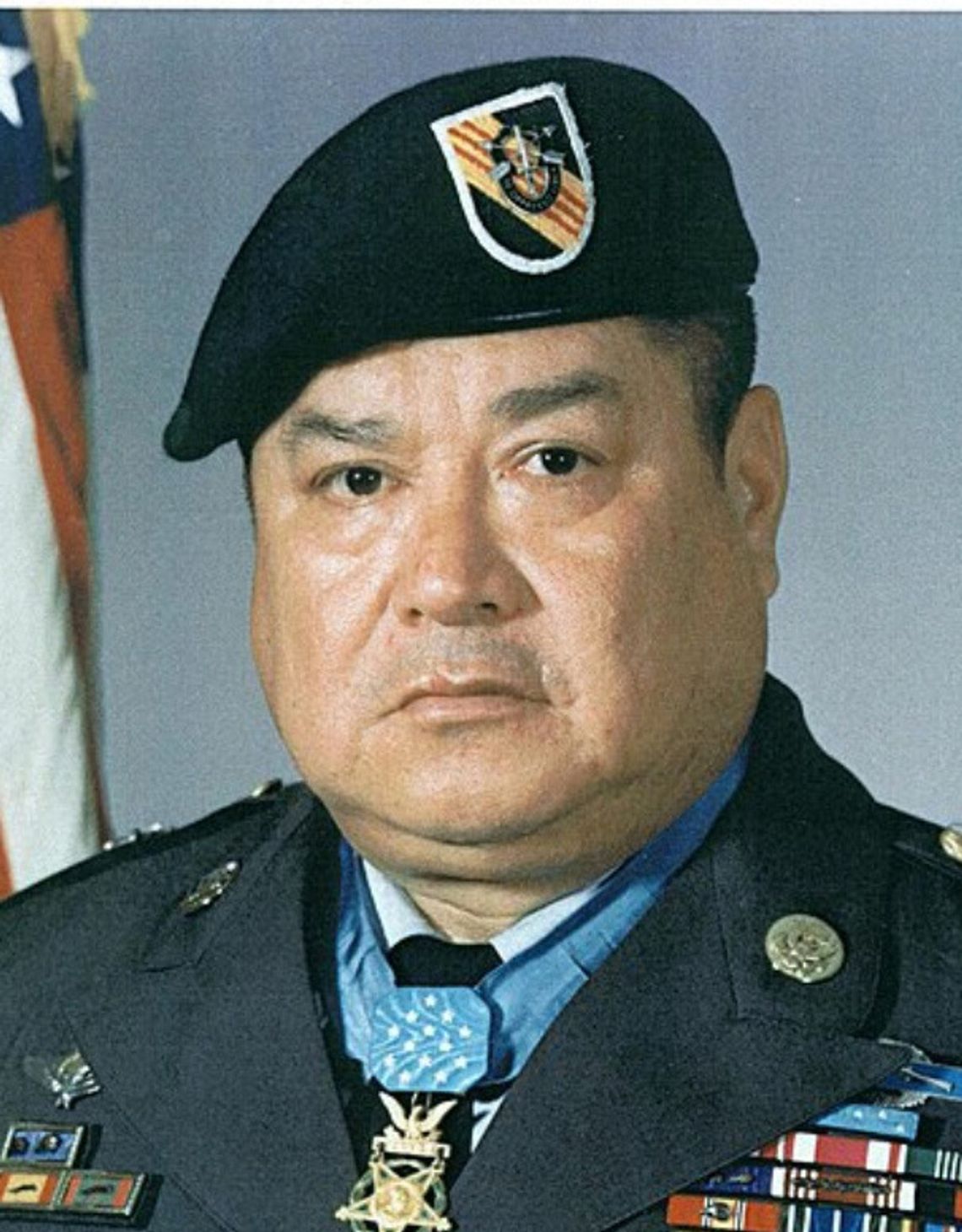
A Medal of Honor recipient born in western DeWitt County could one day be honored with a statue in the proposed National Garden of American Heroes, a federally backed monument planned for the Black Hills near Mount Rushmore in South Dakota.
The proposal comes just days after De-Witt County commissioners approved a resolution supporting efforts to name the new Veterans Affairs hospital in Victoria after Master Sgt. Roy P. Benavidez, who was born in the Lindenau community before lat- er making El Campo his home.
The garden would include 250 sculptures honoring Americans from all walks of life, although the project has been the subject of nearly six years of debate over whether it will ultimately become a reality.
Benavidez, a Medal of Honor recipient, is on the short list of proposed honorees. Other names on the list include George S. Patton Jr., John Adams, Ronald Reagan, Elvis Presley, Barbara Jordan, Nat King Cole, Red Cloud, Roberto Clemente, Audie Murphy, Francis Scott Key, Martin Luther King Jr., Walt Disney and Neil Armstrong.
The monument was first envisioned by President Donald Trump in Executive Order 13934, issued July 3, 2020. The project struggled with funding after President Joe Biden rescinded the order, but it was revived following President Trump's return to office in 2025.
As part of the One Big Beautiful Bill Act in May 2025, the garden received $40 million in funding through the Department of the Interior.
'We do not know if this garden will ever come to fruition, but for my grandfather's name to be among the names of some of the greatest American icons in the 250 years of our nation's history is truly an honor,' said Matthew Benavidez.
His father, Noel Benavidez, is one of Roy and Lala Benavidez's three children, along with Yvette Benavidez Garcia and Denise Prochazka. Each has children who have been taught about the legacy of the grandfather few of them were old enough to remember meeting.
The garden envisions classical or realistic-style renderings, only slightly larger than life, created from marble, granite, bronze, copper or brass.
'Out of all the American icons and heroes the President's team has selected the orphaned farmer boy from Cuero, Texas, who was in the right place at the right time to help his friends and brothers in arms,' Matthew Benavidez said.
'His name will be alongside the names of Betsy Ross, Theodore Roosevelt, Thomas Jefferson, Davy Crockett, Albert Einstein, William McKinley and George Washington, to name a few. It is such an honor to think his contribution to his community, to the military, to the youth and to the nation as a whole has had such a profound impact that he is considered to be recognized among the heroes who helped shape this nation,' he added.
Despite being one of the most recognized figures of the Vietnam War nationally, little in the area honors the Green Beret who, after being injured so severely doctors told him he would spend the rest of his life in a wheelchair, refused to accept that limitation. He taught himself to walk again by first crawling across the hospital floor and then pulling himself up against a wall.
His determination to stay on active duty led to another tour in Vietnam, a deployment that resulted in what he later called 'Six Hours in Hell' on May 2, 1968, when he volunteered for a rescue mission after learning three previous attempts had failed.
Facing odds estimated at 100 to 1, Benavidez, armed with only a knife and a medical bag, saved eight of 12 men, recovered classified documents and suffered 37 bullet, stab and shrapnel wounds.
And while it may not sound polite in the civilian world, few soldiers will forget that Benavidez came home alive because he somehow foundthestrength to spit in the face of the men who believed he was dead and were preparing to place him in a body bag.
After many more years of stateside service, Benavidez returned to El Campo with his wife and children upon his retirement in 1976. The town had thrown him a parade when the Army awarded him the Distinguished Service Cross for his actions during those six hours in hell.
He had also been nominated for the Medal of Honor. The military conducts an extensive investigation of every nomination, including requiring eyewitness testimony. In Benavidez's case, many of the witnesses had been killed or seriously wounded.
Lt. Col. Ralph R. Drake quickly began working to ensure Benavidez received the recognition he deserved. The eight rescued men testified, but the process ultimately required testimony from radio operator Brian O'Conner, who had left the United States after the war and did not know he was needed.
Somehow, however, O'Conner happened to read a story published in the El Campo Leader- News seeking witnesses and contacted officials.
President Ronald Reagan awarded Benavidez the Medal of Honor, the nation's highest military decoration, on Feb. 24, 1981.
Following his retirement, Benavidez traveled extensively, often asking only that his travel and lodging expenses be covered, speaking to military units and students about service, his wartime experiences and themeaningoftheWest Point motto, 'Duty, Honor, Country.'
Benavidez also became the first noncommissioned officer in U.S. history to receive a West Point saber.
'I do not often think about the impact he has had on people I have never met, but he truly is not only a Texas icon, but an American icon, and I am truly thankful to all those who remember his name and echo his story as a true American patriot,' Matthew Benavidez said.