


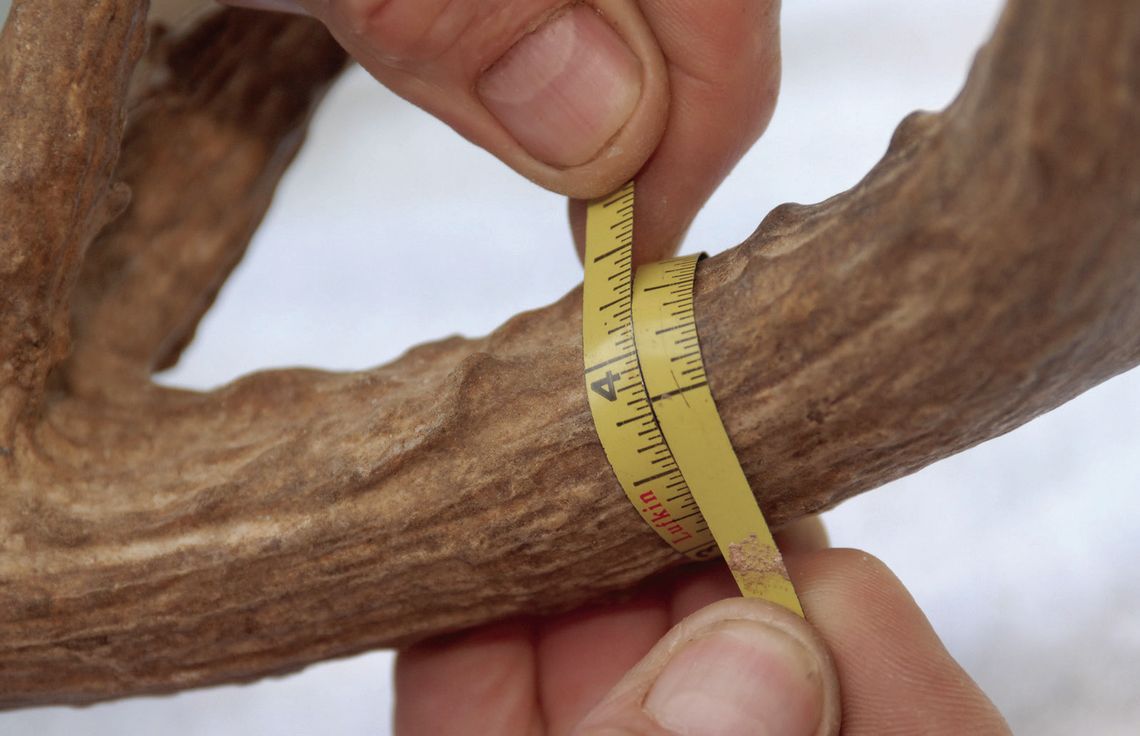
It hardly ever fails. Kill a buck worthy of a trip to the taxidermist these days and sooner later someone is sure to pop the question — what does it score?
Often times, Texas hunters look to experts like Micah Poteet to learn the true tale of tape.
Poteet worked as wildllife biologist for the Texas Parks and Wildlife Department for 28 years before retiring in 2021. Scoring whitetails for the Texas Big Game Awards Program each fall and winter was part the gig.
TBGA is an annual hunter/landowner recognition program run jointly by the Texas Wildlife Association and TPWD. The program has been keeping records on Texas whitetails and other big game animals since the early 1990s.
Promoting conservation and quality wildlife management while showcasing Texas' great hunting is the name of the game with TBGA. Hunters are invited to have whitetail deer, mule deer, pronghorn antelope and bighorn sheep evaluated by certified scorers for entry into 'scored entry' categories. There also are categories for javelina, youth and first harvest.
The program utilizes the Boone and Crockett scoring method to rank qualifying entries in multiple geographic regions. Poteet is one of dozens of TBGA certified scorers currently listed on the TBGA website, texasbiggameawards. org.
The B&C format also is the scoring standard for the Pope and Young Club and commonly used among entries to the Texas Buck Registry. P&Y is an official registry for assorted North American big game animals taken with archery gear. The TBR website (texasbuckregistry. com) is a central place for all Texas deer hunters to post pictures, B&C scores and other pertinent information about their deer harvests. It features a searchable data base that allows for viewing harvests by county or region.
In 2014, Poteet took his scoring academics to the next level when he attended a weeklong school to earn his certification as an official scorer for the Boone and Crockett Club. Based in Missoula, Mont., B&C is recognized as the official records keeper for native North American big game animals taken on open range by legal hunting methods. The B&C records program includes trophies taken by rifle, bow, hand gun and other methods.
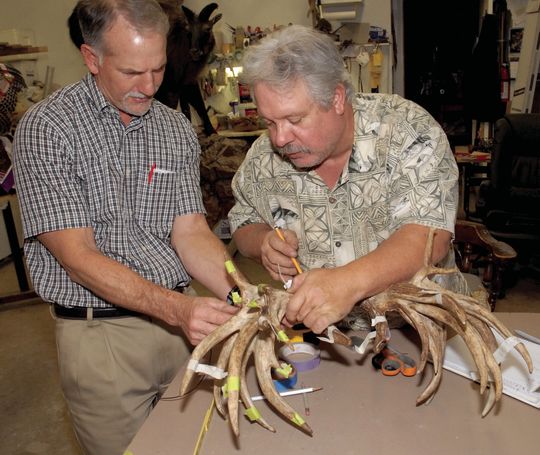
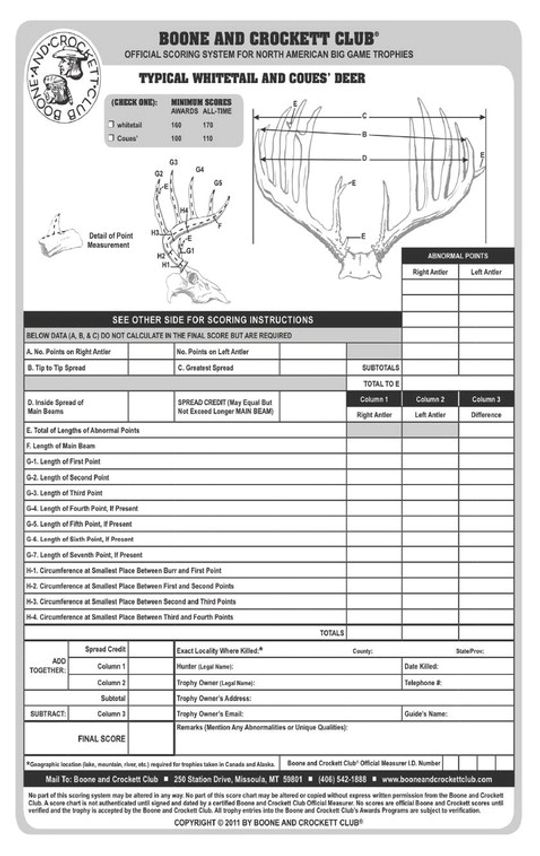
The scoring system takes into account a variety of antler characteristics to tally a score. Among them are the length of scoreable points (one inch or longer), beam length, circumference and inside spread. After performing a series of measurements, the figures are tallied to reach a 'gross' score.
Calculated differences between the left and right antler are deducted to determine the 'net' score.
Poteet has evaluated hundreds of whitetails over the years. He says scoring the big game animals is somewhat of a labor of love that runs hand-in-hand with his passion for hunting. His B&C certification qualifies him to score a variety North American big game animals for possible entry to B&C’s All-Time and Awards record books.
The biologist pointed out there are two different categories of antlers — typicals and non-typicals. Typicals are considered normal antlers with matching points on both sides that reach upwards from the usual locations.
A non-typical set of antlers may carry the same number of typical points on both sides with additional points that originate from locations other than the top of main beam. Kickers, drop tines etc... are considered abnormal points.
The level of difficulty involved in scoring antlers varies from one deer to the next. As a rule, typical antlers are easiest, Poteett said.
The process for scoring typical antlers is pretty much cut and dry. To wit: Scoring a typical consists of gathering four circumference measurements on each side, main beam lengths, length of each point and inside spread using a 1/4inch wide flexible steel tape to the nearest oneeighth of an inch or a thin steel cable.
Where scorers can run to problems is when there is some type of deviation from the norm. Poteet says evaluating and interpreting non-typical growth can be especially challenging at times.
“Typical deer are pretty straight forward,” he said. “With non-typicals, it’s those really crazy ones with a lot of points, webbing or palmation where things can really get complicated. There are a lot of decisions to make on some of those deer -- lots of judgement calls. It’s not uncommon to spend 2-3 hours on a really crazy non-typical, whereas a typical eight pointer might take 30 minutes.”
Poteet says it is never a bad idea to have multiple sets of trained eyes around when scoring a whitetail rack with a high level difficulty. On more one occasion he as consulted with other scorers, or sent pictures to B&C headquarters for second opinions, when faced with judgement calls he was unsure about.
Another great source of information on scoring is the Boone and Crockett Club — Pope and Young Club Official Measurers Manual. Fittingly titled “How to Score North American Big Game, 5th Edition,” the 280-page book is available in a soft cover, spiral bound edition or it can be downloaded in a PDF format from the B&C website (boone-crockett. org) for $45.
Individual chapters can be downloaded for $10.
The manual is a useful addition to every hunter’s library or ideal to have around hunting camps It includes detailed measuring instructions and score chart examples for white-tailed deer, Coues’ whitetail deer, bear, cougar, walrus, American elk, Roosevelt’s elk, Tule elk, Mule deer, Blacktail deer, moose, caribou, pronghorn antelope, bison, Rocky Mountain goat, Musk ox and sheep.
The full color manual features over 150 drawings, photos and maps. It offers the most current scoring techniques with easyto- follow instructions for the categories recognized by each organization. There are 38 categories for B&C and 36 for P&Y.
Matt Williams is a freelance writer based in Nacogdoches. He can be reached by email, mattwillwrite4u@yahoo. com.